Commercial AC repairs: Why 1-hour response matters for property managers
By Be Cool Air Conditioning 11 min read
When Minutes Matter: The True Cost of AC Downtime
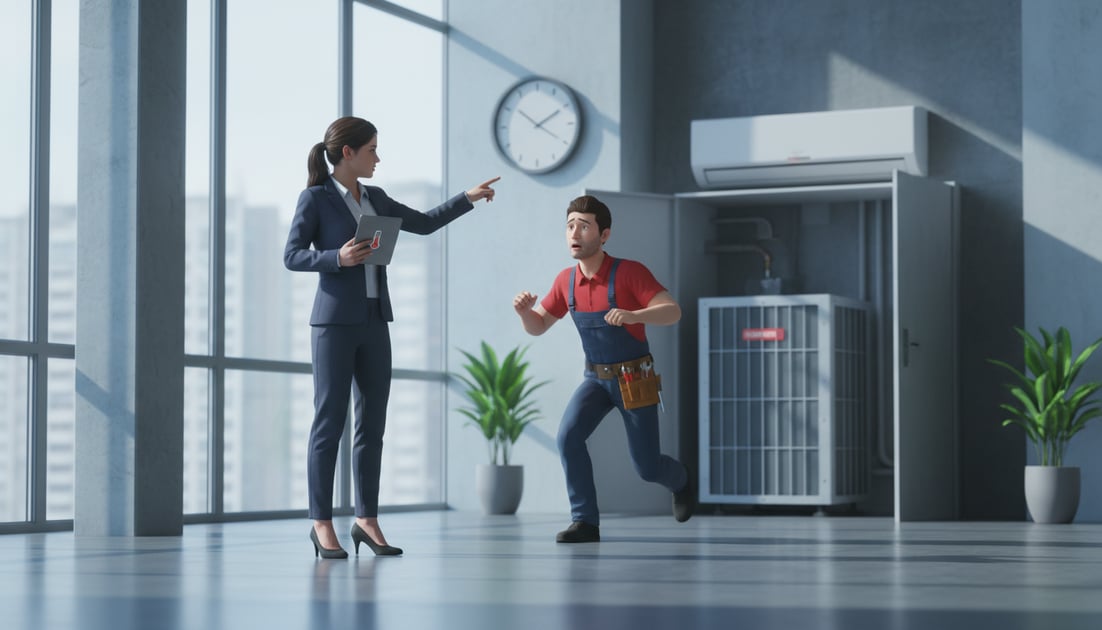
Commercial AC repairs demand rapid response because every hour of system downtime directly impacts your bottom line, tenant satisfaction, and legal obligations. Be Cool Air Conditioning's one-hour response commitment addresses this critical need head-on.
Consider the real financial exposure. Retail environments lose an average of £1,200 per hour during summer AC failures as customers simply leave uncomfortable stores. Office buildings face productivity drops of up to 25% when temperatures exceed 24°C, whilst hotels risk immediate negative reviews and booking cancellations. Recent TM44 inspections revealed that poorly maintained commercial HVAC systems consume 30-40% more energy, compounding operational costs even before emergency breakdowns occur.
Beyond immediate revenue loss, extended response windows create cascading problems. Perishable stock spoilage in retail settings, regulatory compliance failures in temperature-controlled environments, and potential Health and Safety Executive violations all stem from delayed commercial ac repairs. London businesses that implemented preventative maintenance programmes reduced emergency callout costs by 60% annually whilst avoiding the severe financial impact of unexpected system downtime.
Fast service isn't just convenient – it's essential protection for your property's operational efficiency and your professional reputation as a property manager.
What is a Reasonable Amount of Time for Repairs?
A data centre in Manchester experienced AC failure at 2pm on a Friday afternoon. Their maintenance partner arrived at 4:30pm – industry standard response – but server room temperatures had already reached critical levels. The two-and-a-half-hour response window cost them £8,400 in emergency cooling equipment hire alone.
Industry benchmarks vary dramatically based on contract tier and property type. Understanding these standards helps you evaluate whether your current maintenance partner meets commercial requirements.
| Response Tier | Typical Response Window | Suitable For |
|---|---|---|
| Standard Service | 4-8 hours | Low-occupancy buildings, non-critical systems |
| Priority Service | 2-4 hours | Standard office environments, retail premises |
| Emergency Service | 1 hour or less | Hospitals, data centres, hotels, high-occupancy retail |
Most commercial contracts specify 4-hour response times as standard, with repair completion targets ranging from same-day to 48 hours depending on parts availability. However, Building Regulations Part F compliance requires functional ventilation systems in occupied commercial spaces, making extended response windows legally problematic for property managers.
Be Cool Air Conditioning's one-hour response commitment addresses the gap between standard service levels and commercial reality. When your HVAC system fails during peak trading hours or heatwave conditions, waiting four hours transforms a manageable situation into a crisis affecting tenant comfort, regulatory compliance, and revenue streams.
High-occupancy environments cannot afford standard response windows. A hotel with 200 occupied rooms or a restaurant during lunch service needs commercial AC repair services that prevent customer exodus, not damage limitation after guests have already left negative reviews. For commercial properties where system downtime directly impacts operations, one-hour response isn't premium service – it's baseline protection for your investment and professional obligations.
Why Property Managers Can't Afford to Wait: The Business Impact
Delayed commercial AC repairs create measurable consequences that extend far beyond temporary discomfort. Property managers face three critical exposure areas when response times exceed operational needs.
- Financial Losses Multiply Rapidly – System downtime generates immediate revenue impact through lost productivity, customer departure, and emergency mitigation costs. A failed HVAC system in a 50-person office reduces work output by up to 25% as temperatures climb, costing approximately £500-£800 per hour in wasted salary expense. Retail premises experience even steeper losses when shoppers abandon overheated environments during peak trading periods, whilst restaurants face complete service interruption during lunch and dinner rushes.
- Legal Compliance Risks Escalate – The Workplace (Health, Safety and Welfare) Regulations 1992 require 'reasonable' indoor temperatures for commercial premises, though no maximum threshold exists in law. However, HSE guidance establishes minimum standards of 16°C for sedentary work environments. Extended response windows place you at risk of Health and Safety Executive investigations if employees work in excessively hot conditions. Temperature-controlled environments face additional regulatory exposure when AC failures compromise product safety or storage requirements.
- Reputation Damage Becomes Permanent – Today's tenants and customers broadcast their experiences instantly through online reviews and social media. A single AC failure during summer heatwave conditions generates negative feedback that persists for years, affecting future letting prospects and property valuations. Hotels cannot recover from guests who've already posted one-star reviews about unbearable room temperatures, regardless of how quickly you eventually restore comfort.
Be Cool Air Conditioning's emergency response model protects property managers from these compounding risks. Rapid commercial AC services prevent manageable technical issues from becoming business-critical incidents that damage your professional standing and tenant relationships. When your maintenance partner arrives within 60 minutes, you maintain control of the situation before financial losses accumulate and reputation damage spreads beyond recovery.
Who is Responsible for Repairs on a Commercial Lease?
Commercial lease agreements typically assign HVAC maintenance obligations based on the Full Repairing and Insuring (FRI) lease structure, where tenants assume responsibility for internal repairs including air conditioning systems. However, landlords often retain structural obligations that can include base building HVAC infrastructure, creating potential grey areas when commercial AC failures occur.
The practical challenge emerges during emergency situations. Whilst your lease document may clearly state tenant responsibility for routine maintenance, urgent AC failures during heatwave conditions cannot wait for contractual interpretation. A restaurant experiencing system breakdown during Saturday lunch service needs immediate commercial ac repairs regardless of whether the tenant or landlord ultimately bears the cost.
Property managers occupy the critical middle position in this relationship. You carry the duty to respond quickly when tenants report HVAC issues, coordinate emergency repair services, and prevent business disruption whilst legal and financial responsibilities are determined later. HSE guidance on workplace temperature standards applies immediately to occupied commercial premises, making delayed response legally problematic regardless of who pays the final invoice.
Smart maintenance contracts eliminate ambiguity by establishing clear protocols before emergencies arise. Be Cool Air Conditioning works with property managers to create response frameworks that prioritise operational continuity over administrative disputes. When your commercial AC fails, tenants need technicians arriving within 60 minutes, not discussions about clause interpretation. Pre-arranged emergency callout agreements ensure rapid service delivery whilst preserving your ability to allocate costs appropriately under existing lease terms.
How 1-Hour Response Actually Works: Technology and Logistics
Delivering 60-minute commercial AC repairs requires integrated logistics platforms that most maintenance providers lack. Be Cool Air Conditioning's emergency response capability depends on three coordinated operational systems.

Step 1: Real-Time Engineer Location Tracking – GPS-enabled dispatch platforms identify the nearest qualified technician to your property within seconds of your emergency call. This technology eliminates manual coordination delays that extend standard response windows to 4+ hours. Engineers receive automated route optimisation that accounts for current traffic conditions, reducing travel time by up to 35% compared to traditional dispatch methods.
Step 2: Mobile Parts Inventory Management – Each service vehicle carries pre-stocked components for the 80% of commercial AC failures that require immediate replacement parts. Digital inventory systems track component usage across the fleet, triggering automatic restocking to maintain readiness. When your HVAC system fails, technicians arrive with capacitors, contactors, and refrigerant already on board rather than requiring secondary trips to suppliers.
Step 3: Automated Callout Prioritisation – Building management platforms assess incoming service requests against property type, occupancy levels, and contractual commitments. High-occupancy retail premises and temperature-sensitive environments receive immediate engineer allocation, whilst non-critical repairs queue appropriately. This intelligent triage ensures emergency AC repair services reach properties where system downtime creates the greatest business impact.
These interconnected platforms transform one-hour response from marketing promise into operational reality for property managers managing multiple commercial sites.
How Do You Approach Troubleshooting When Faced with Complex HVAC Issues?
Commercial HVAC diagnostics require fundamentally different methodologies than residential troubleshooting because system complexity, occupancy impact, and operational consequences demand specialised expertise. Be Cool Air Conditioning's engineers follow structured protocols that address commercial environments' unique challenges.
- Systematic Zone Analysis Before Component Testing – Commercial systems serve multiple zones with independent controls, requiring engineers to isolate whether failures originate from central plant equipment or distributed components. We map symptom patterns across affected areas first, identifying whether your issue stems from rooftop units, air handling systems, or zone-specific controls. This prevents wasted diagnostic time testing individual components when building automation system faults affect entire floors.
- Real-Time Data Integration From Building Management Systems – Modern commercial installations generate continuous performance data through IoT sensors and automation platforms. Our technicians download operational logs showing temperature fluctuations, pressure readings, and runtime patterns before physical inspection begins. This evidence-led approach identifies intermittent faults that wouldn't appear during standard visual assessments, reducing diagnostic time by 40% compared to traditional methods.
- Load Calculation Verification Against Occupancy Changes – Unlike residential properties, commercial buildings experience significant occupancy variations that strain HVAC capacity. We assess whether common AC problems result from equipment failure or insufficient capacity for current usage patterns. Retail premises converted from storage, offices with increased server room loads, or buildings with added floors often experience performance issues that component replacement cannot resolve.
- Multi-System Interaction Assessment – Commercial HVAC failures frequently involve cascading effects across ventilation, refrigeration, and control systems. Our diagnostic process examines how your AC interacts with fresh air handling, heat recovery systems, and energy management platforms rather than treating air conditioning as an isolated system.
This methodical approach ensures accurate commercial ac repairs that address root causes rather than visible symptoms.
Seasonal Risks: When UK Commercial AC Systems Are Most Vulnerable
UK commercial AC systems face distinct vulnerability patterns that directly correlate with our climate cycles. Understanding these seasonal pressure points helps property managers anticipate failures before they disrupt operations.
Summer heatwaves create the highest failure risk. The record-breaking 2025 summer drove AC installations up 63% between July and September, but existing systems experienced unprecedented strain. Commercial HVAC platforms running continuously during prolonged hot periods suffer compressor failures, refrigerant leaks, and electrical component burnout. Your system faces maximum load precisely when replacement parts become scarce and every maintenance partner operates at capacity.

Spring and autumn transitions present hidden dangers. UK commercial buildings typically schedule major HVAC checks during these shoulder seasons, yet sudden temperature spikes catch unprepared systems off-guard. A March heatwave or September warm spell forces dormant AC units into immediate operation without the gradual startup that reveals developing issues.
| Season | Primary Risk | Typical Failure Mode |
|---|---|---|
| Summer | Continuous high load | Compressor failure, refrigerant loss |
| Spring | Abrupt startup demand | Control system faults, blocked filters |
| Autumn | Delayed maintenance | Corrosion damage, sensor drift |
| Winter | System dormancy | Seized components, moisture ingress |
Winter dormancy creates February and March vulnerabilities when systems restart after months of inactivity. Seized bearings, moisture accumulation, and degraded seals only become apparent when you need cooling during unexpected warm periods.
Be Cool Air Conditioning's preventative maintenance programmes address these seasonal patterns before they generate emergency callouts during your busiest trading periods.
Choosing a 1-Hour Response Provider: Your Vetting Checklist
Not all emergency commercial AC providers deliver genuine one-hour response despite marketing claims. Protect your property with this evidence-based vetting framework before committing to a maintenance partner.
- F-Gas Certification Verification – Confirm technicians hold current F-Gas certificates enabling legal refrigerant handling. Request certification numbers and verify through the Refcom register. Uncertified engineers cannot complete most commercial ac repairs, turning promised one-hour response into multi-day delays whilst certified contractors are sourced.
- Geographic Coverage Mapping – Ask providers to specify their service radius with documented average response times by postcode. Companies claiming London-wide coverage may operate from single depots in Croydon, making genuine 60-minute arrivals impossible for properties in Barnet or Newham. Be Cool Air Conditioning maintains strategically positioned engineers ensuring consistent response across our service area.
- Mobile Inventory Confirmation – Request detailed lists of parts stocked in service vehicles. Providers carrying comprehensive component inventories complete 75% of repairs during initial callouts, whilst those relying on parts collection extend resolution times by 4-8 hours regardless of arrival speed.
- Contractual Response Guarantees – Examine whether one-hour commitments appear in written service agreements with defined consequences for missed targets. Verbal promises lack enforcement mechanisms when you're managing an overheated retail premises at 2pm on Saturday.
- Out-of-Hours Availability Documentation – Verify 24/7 callout capability through published emergency contact procedures. Test response protocols during evening hours before signing contracts, as many providers outsource after-hours calls to answering services without dispatch authority.
- Insurance and Liability Coverage – Confirm minimum £5 million public liability insurance and professional indemnity coverage protecting against repair-related damages. Review commercial AC maintenance credentials thoroughly before granting building access.
Thorough vetting separates genuine emergency capabilities from marketing rhetoric.
Protecting Your Property Investment with Rapid Response
When commercial AC systems fail, property managers need certainty, not promises. Be Cool Air Conditioning's one-hour response commitment protects your investment by preventing minor technical issues from escalating into business-critical incidents that damage tenant relationships and operational performance.
Fast emergency AC repair delivers three measurable advantages: immediate financial loss prevention through reduced downtime, maintained regulatory compliance during occupied hours, and preserved professional reputation before negative feedback spreads. Our 20+ years' experience ensures technicians arrive equipped with diagnostic expertise and pre-stocked components that resolve 75% of commercial failures during initial callouts.
Property managers cannot control when HVAC systems fail, but you absolutely control your response capability. Partner with maintenance providers who demonstrate verifiable one-hour commitments through GPS dispatch platforms, mobile inventory systems, and contractual guarantees with enforcement mechanisms.
Contact Be Cool Air Conditioning today to establish rapid response protection for your commercial portfolio before the next heatwave tests your current maintenance arrangements.